 |
| Subiectul anterior :: Subiectul urmator |
| Autor |
Mesaj |
halebardul

Data inscrierii: 02/Iul/2009
Mesaje: 2676
|
 Trimis: Vineri, 07 August 2009 10:21 Titlul subiectului: How was it made ? (aparitia cinematografului) Trimis: Vineri, 07 August 2009 10:21 Titlul subiectului: How was it made ? (aparitia cinematografului) |
 |
|
clipe importante, nu neaparat in ordine cronologica
Phenakistoscope
From Wikipedia, the free encyclopedia
The phenakistoscope (also spelled phenakistiscope) was an early animation device, the predecessor of the zoetrope. It was invented in 1832 simultaneously by the Belgian Joseph Plateau and the Austrian Simon von Stampfer.
One variant of the phenakistoscope was a spinning disc mounted vertically on a handle. Around the center of the disc a series of pictures was drawn corresponding to frames of the animation; around its circumference was a series of radial slits. The user would spin the disc and look through the moving slits at the disc's reflection in a mirror. The scanning of the slits across the reflected images kept them from simply blurring together, so that the user would see a iute succession of images with the appearance of a motion picture (see also persistence of vision).
A phenakistoscope disc by Eadweard Muybridge (1893)

Simulated mirror view of the above disc
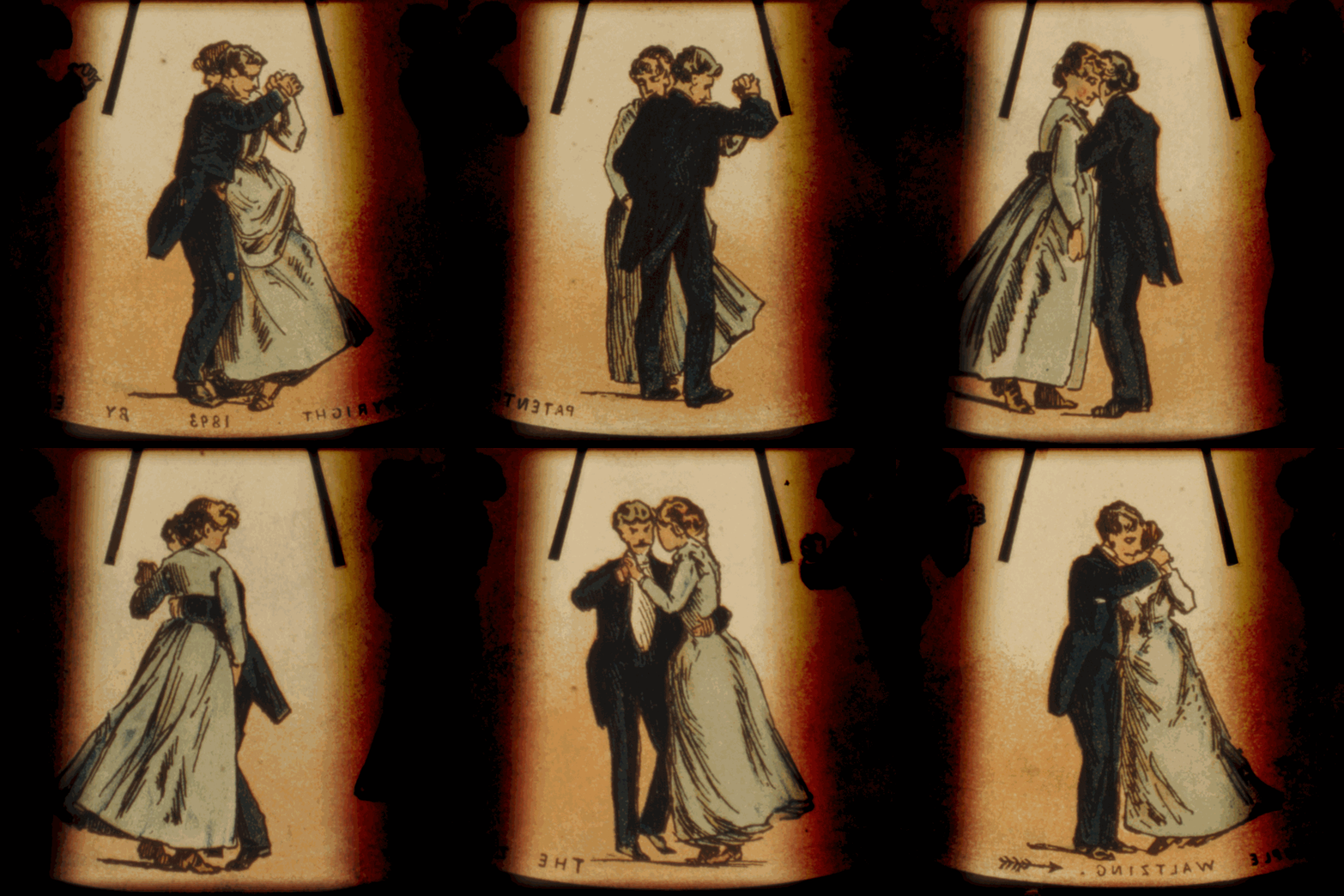
Another variant had two discs, one with slits and one with pictures; this was slightly more unwieldy but needed no mirror. Unlike the zoetrope and its successors, the phenakistoscope could only practically be used by one person at a time.
The word "phenakistoscope" comes from Greek roots meaning "optical deceiver" or "to cheat", as it deceives the eye by making the pictures look like an animation. As technology along with popularity increased in the early twentieth century, coin operation was utilized on machines, coining the term "Nickelodeon," which would be later be used somewhat freely to describe events charging five cents or a "nickel." |
|
| Sus |
|
 |
halebardul
Data inscrierii: 02/Iul/2009
Mesaje: 2676
|
| Trimis: Vineri, 07 August 2009 10:28 Titlul subiectului: |
|
|
Stanford and the galloping question
In 1872, former Governor of California Leland Stanford, a businessman and race-horse owner, had taken a position on a popularly-debated question of the day: whether all four of a horse's hooves left the ground at the same time during a gallop. Stanford sided with this assertion, called "unsupported transit", and took it upon himself to prove it scientifically. (Though legend also includes a wager of up to $25,000, there is no evidence of this.) Stanford sought out Muybridge and hired him to settle the question. Muybridge's relationship with Stanford was long and fraught, heralding both his entrance and exit from the history books.
To prove Stanford's claim, Muybridge developed a scheme for instantaneous motion picture capture. Muybridge's technology involved chemical formulas for photographic processing and an electrical trigger created by the chief engineer for the Southern Pacific Railroad, John D. Isaacs.
In 1877, Muybridge settled Stanford's question with a single photographic negative showing Stanford's racehorse Occident airborne in the midst of a gallop. This negative was lost, but it survives through woodcuts made at the time.
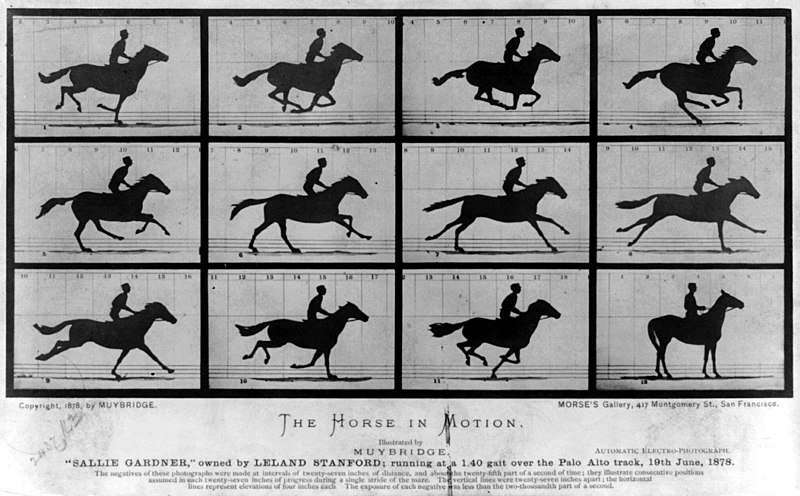
By 1878, spurred on by Stanford to expand the experiment, Muybridge had successfully photographed a horse in fast motion using a series of twenty-four cameras. The first experience successfully took place on June 11 with the press present. Muybridge used a series of 12 stereoscopic cameras, 21 inches apart to cover the 20 feet taken by one horse stride, taking pictures at one thousandth of a second. The cameras were arranged parallel to the track, with trip-wires attached to each camera shutter triggered by the horse's hooves.
This series of photos, taken at what is now Stanford University or in Sacramento, California (there is some dispute as to the actual location), is called The Horse in Motion, and shows that the hooves do all leave the ground — although not with the legs fully extended forward and back, as contemporary illustrators tended to imagine, but rather at the ocazie when all the hooves are tucked under the horse as it switches from "pulling" from the front legs to "pushing" from the back legs.
Muybridge's The Horse in Motion.
A set of Muybridge's photos in motion.
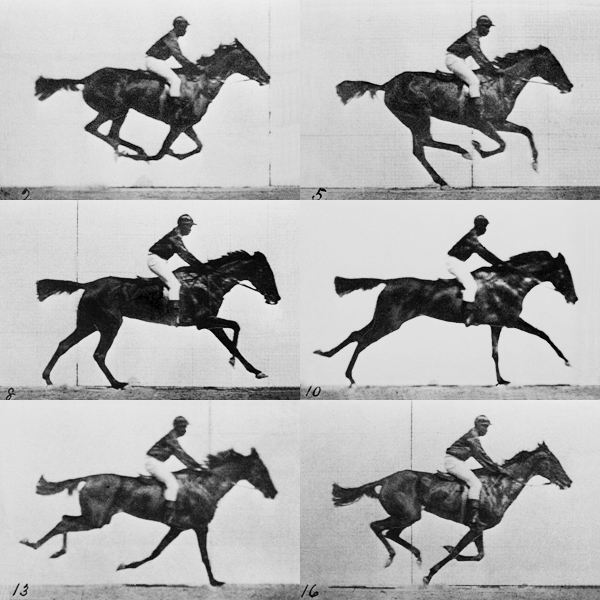
The relationship between the mercurial Muybridge and his patron broke down in 1882 when Stanford commissioned a book called The Horse in Motion as Shown by Instantaneous Photography which omitted actual photographs by Muybridge, relying instead on drawings and engravings based on the photographs and gave Muybridge scant credit for his work.
The lack of photographs was likely simply due to the printing constraints of the time but Muybridge took it as a slap in the face and filed an unsuccessful lawsuit against Stanford. |
|
| Sus |
|
|
halebardul
Data inscrierii: 02/Iul/2009
Mesaje: 2676
|
| Trimis: Vineri, 07 August 2009 10:41 Titlul subiectului: |
|
|
Zoetrope
From Wikipedia, the free encyclopedia
A zoetrope is a device that produces an illusion of action from a rapid succession of static pictures. The term zoetrope is from the Greek words zoe, "life" and trope, "turn". It may be taken to mean "wheel of life" or "living wheel."
It consists of a cylinder with slits cut vertically in the sides. Beneath the slits on the inner surface of the cylinder is a band which has either individual frames from a video/film or images from a set of sequenced drawings or photographs. As the cylinder spins the user looks through the slits at the pictures on the opposite side of the cylinder's interior. The scanning of the slits keeps the pictures from simply blurring together so that the user sees a repede succession of images producing the illusion of motion, the equivalent of a motion picture. Cylindrical zoetropes have the property of causing the images to appear thinner than their actual sizes when viewed in motion through the slits.
A modern replica of a Victorian zoetrope

nvention
The earliest elementary zoetrope was created in China around 180 AD by the prolific inventor Ting Huan (丁緩). Driven by convection Ting Huan's device hung over a lamp. The rising air turned vanes at the top from which were hung translucent paper or mica panels. Pictures painted on the panels would appear to move if the device is spun at the right speed.
The modern zoetrope was invented in 1833 by British mathematician William George Horner. He called it the 'Daedalum' ('the wheel of the devil). It didn't become popular until the 1860s, when it was patented by makers in both England and America. The American developer, William F. Lincoln, named his toy the 'zoetrope', which means 'wheel of life'.
Almost simultaneously similar inventions were made independently in Belgium by Joseph Antoine Ferdinand Plateau (Phenakistoscope) and Austria by Simon von Stampfer , (Stroboscope).
The zoetrope worked on the same principles as the phenakistiscope, but the pictures were drawn on a strip which could be set around the bottom third of a metal drum, with the slits now cut in the upper section of the drum. The drum was mounted on a spindle so that it could be spun, and viewers looking through the slits would see the cartoon strip form a moving image. The faster the drum is spun, the smoother the image that is produced.
Modern times
William F Lincoln promoted Horner's device in the United States as a "zoetrope".
The praxinoscope was an improvement on the zoetrope that became popular toward the end of the nineteenth century.
The earliest projected moving images were displayed by using a magic lantern zoetrope. This crude projection of moving images occurred as early as the 1860s. A magic lantern praxinoscope was demonstrated in the 1880s.
Zoetrope development continues into the twenty-first century, primarily with the "Linear zoetrope." A linear zoetrope consists of an opaque linear screen with thin vertical slits in it. Behind each slit is an image, often illuminated. One views the motion-picture by moving past the display.
Linear zoetropes have several differences compared to cylindrical zoetropes that derive from their different geometries. They can have arbitrarily long animations. They also cause images to appear wider than their actual sizes when viewed in motion through the slits. |
|
| Sus |
|
|
halebardul
Data inscrierii: 02/Iul/2009
Mesaje: 2676
|
| Trimis: Vineri, 07 August 2009 10:44 Titlul subiectului: |
|
|
Zoopraxiscope
From Wikipedia, the free encyclopedia
The zoopraxiscope is an early device for displaying motion pictures. Created by photographic pioneer Eadweard Muybridge in 1879, it may be considered the first movie projector. The zoopraxiscope projected images from rotating glass disks in rapid succession to give the impression of motion. The stop-motion images were initially painted onto the glass, as silhouettes. A second series of discs, made in 1892-94, used outline drawings printed onto the discs photographically, then colored by hand. Some of the animated images are very complex, featuring multiple combinations of sequences of animal and human movement.
Zoopraxiscope disc by Eadweard Muybridge.

Simulation of a spinning zoopraxiscope.

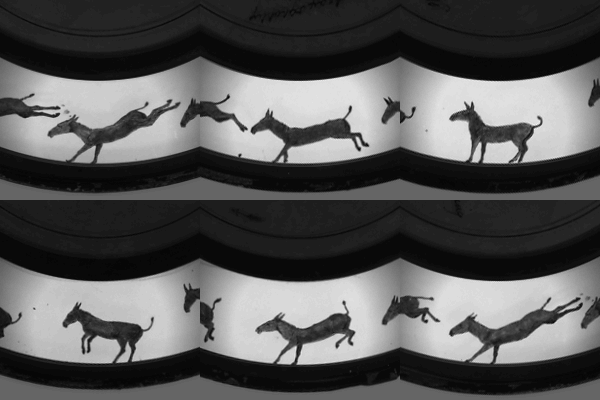
The device appears to have been one of the primary inspirations for Thomas Edison and William Kennedy Dickson's Kinetoscope, the first commercial film exhibition system. Images from all of the known seventy-one surviving zoopraxiscope discs have recently been reproduced in the book Eadweard Muybridge: The Kingston Museum Bequest (The Projection Box, 2004). |
|
| Sus |
|
|
halebardul
Data inscrierii: 02/Iul/2009
Mesaje: 2676
|
| Trimis: Vineri, 07 August 2009 11:03 Titlul subiectului: |
|
|
Kinetoscope
From Wikipedia, the free encyclopedia
The Kinetoscope is an early motion picture exhibition device. Though not a movie projector—it was designed for films to be viewed individually through the window of a cabinet housing its components—the Kinetoscope introduced the basic approach that would become the standard for all cinematic projection before the advent of video: it creates the illusion of movement by conveying a strip of perforated film bearing sequential images over a light source with a high-speed shutter. First described in conceptual terms by U.S. inventor Thomas Edison in 1888, it was largely developed by his employee William Kennedy Laurie Dickson between 1889 and 1892. Dickson and his team at the Edison lab also devised the Kinetograph, an innovative motion picture camera with rapid intermittent, or stop-and-go, film movement, to photograph movies for in-house experiments and, eventually, commercial Kinetoscope presentations.
Interior view of Kinetoscope with peephole viewer at top of cabinet

In April 1894, the first commercial exhibition of motion pictures in history was given in New York City, using ten Kinetoscopes. Instrumental to the birth of American movie culture, the Kinetoscope also had a major impact in Europe; its influence abroad was magnified by Edison's decision not to seek international patents on the device, facilitating numerous imitations of and improvements on the technology. In 1895, Edison introduced the Kinetophone, which joined the Kinetoscope with a cylinder phonograph. Film projection, which Edison initially disdained as financially nonviable, soon superseded the Kinetoscope's individual exhibition model. Many of the projection systems developed by Edison's firm in later years would use the Kinetoscope name.
Development
An encounter with the work and ideas of photographic pioneer Eadweard Muybridge appears to have spurred Edison to pursue the development of a motion picture system. On February 25, 1888, in Orange, New Jersey, Muybridge gave a lecture that may have included a demonstration of his zoopraxiscope, a device that projected sequential images drawn around the edge of a glass disc, producing the illusion of motion. The Edison facility was very close by, and the lecture was possibly attended by both Edison and his company's official photographer, William Dickson. Two days later, Muybridge and Edison met at Edison's laboratory in West Orange; Muybridge later described how he proposed a collaboration to join his device with the Edison phonograph—a combination system that would play sound and images concurrently.[1] No such collaboration was undertaken, but in October 1888, Edison filed a preliminary claim, known as a caveat, with the U.S. Patent Office announcing his plans to confecționate a device that would do "for the Eye what the phonograph does for the Ear". It is clear that it was intended as part of a complete audiovisual system: "we may see & hear a whole Opera as perfectly as if actually present".[2] In March 1889, a second caveat was filed, in which the proposed motion picture device was given a name, Kinetoscope, derived from the Greek roots kineto ("movement") and scopos ("to view").
Edison assigned Dickson, one of his most talented employees, to the job of making the Kinetoscope a reality. Edison would take full credit for the invention, but the historiographical consensus is that the title of creator can hardly go to one man:
While Edison seems to have conceived the idea and initiated the experiments, Dickson apparently performed the bulk of the experimentation, leading most modern scholars to assign Dickson with the major credit for turning the concept into a practical reality. The Edison laboratory, though, worked as a collaborative organization. Laboratory assistants were assigned to work on many projects while Edison supervised and involved himself and participated to varying degrees.

Dickson and his then lead assistant, Charles Brown, made halting progress at first. Edison's original idea involved recording pinpoint photographs, 1/32 of an inch wide, directly on to a cylinder (also referred to as a "drum"); the cylinder, made of an opaque material for positive images or of glass for negatives, was coated in collodion to provide a photographic base.[4] An audio cylinder would provide synchronized sound, while the rotating images, hardly operatic in scale, were viewed through a microscope-like tube. When tests were made with images expanded to a mere 1/8 of an inch in width, the coarseness of the silver bromide emulsion used on the cylinder became unacceptably apparent. Around June 1889, the lab began working with sensitized celluloid sheets, supplied by John Carbutt, that could be wrapped around the cylinder, providing a far superior base for the recording of photographs.[5] The first film made for the Kinetoscope, and apparently the first motion picture ever produced on photographic film in the United States, may have been shot at this time (there is an unresolved debate over whether it was made in June 1889 or November 1890); known as Monkeyshines, No. 1, it shows an employee of the lab in an apparently tongue-in-cheek display of physical dexterity.[6] Attempts at synchronizing sound were soon left behind, while Dickson would also experiment with disc-based exhibition designs.
Going public
Construction on the imposing Black Maria began in December 1892. In order to take full advantage of sunlight, the tar paper–lined studio was equipped with a hinged, flip-up roof and the entire structure could rotate on a track. "It obeys no architectural rules," declared Dickson, who found it "productive of the happiest effects in the films."

The premiere of the completed Kinetoscope was held not at the Chicago World's Fair, as originally scheduled, but at the Brooklyn Institute of Arts and Sciences on May 9, 1893. The first film publicly shown on the system was Blacksmith Scene (aka Blacksmiths); directed by Dickson and shot by Heise, it was produced at the new Edison moviemaking studio, known as the Black Maria.[37] Despite extensive promotion, a major display of the Kinetoscope, involving as many as twenty-five machines, never took place at the Chicago exposition. Kinetoscope production had been delayed in part because of Dickson's absence of more than eleven weeks early in the year with a nervous breakdown.
A San Francisco Kinetoscope parlor, ca. 1894–95.

The 1895 version of the Kinetophone in use, showing the earphones that lead to the cylinder phonograph within the cabinet

Projecting Kinetoscopes
As seen in this ad from the first decade of the 1900s, years before developing the compact Home Projecting Kinetoscope, Edison marketed an essentially theatrical 35 mm Projecting Kinetoscope for domestic use.
Over the course of 1895, it became clear that the Kinetoscope was going to lose out on one end to projected motion pictures and, on the other, to a new "peep show" device, the cheap, flip-book-based Mutoscope. In its second year of commercialization, the Kinetoscope operation's profits plummeted by more than 95 percent, to just over $4,000.[75] The Latham brothers and their father, Woodville, had retained the services of former Edison employee Eugene Lauste and then, in April 1895, Dickson himself to develop a film projection system. On May 20, in New York City, the new Eidoloscope was used for the first commercial screening of a motion picture, four minutes of pugilism between Young Griffo and Charles Barnett.[76] European inventors, most prominently the Lumières and Germany's Skladanowsky brothers, were moving forward with similar systems.
By the beginning of 1896, Edison had turned his attention to promoting a projector technology, the Phantoscope, developed by young inventors Charles Francis Jenkins and Thomas Armat. The rights to the system had been acquired by Raff and Gammon, who redubbed it the Vitascope and arranged with Edison to present himself as its creator.[77] With Dickson having left his employ, the Kinetophone was soon mothballed and Edison suspended work on sound cinema for an extended period. Departing the Vitascope operation after little more than a year, Edison commissioned the development of his own projection systems, the Projectoscope and then multiple iterations of the Projecting Kinetoscope. In 1912, he introduced the ambitious and expensive Home Projecting Kinetoscope, which employed three parallel strips of 22 mm film. Four years later, the Edison operation came out with its last substantial new film exhibition technology, a short-lived theatrical system called the Super Kinetoscope. Much of the Edison company's most creative work in the motion picture field from 1897 on involved the use of Kinetoscope-related patents in threatened or actual lawsuits for the purpose of financially pressuring or blocking commercial rivals.
Image of a Projecting Kinetoscope published in 1914.

As far back as the Vitascope days, some exhibitors had screened films accompanied by phonographs playing appropriate, though very roughly timed, sound effects; in the style of the Kinetophone described above, rhythmically matching recordings were also made available for march and dance subjects.[79] While Edison oversaw cursory sound-cinema experiments after the success of The Great Train Robbery (1903) and other Edison Manufacturing Company productions, it was not until 1908 that he returned in earnest to the combined audiovisual concept that had first led him to enter the motion picture field. Edison patented a synchronization system connecting a projector and a phonograph, located behind the screen, via an assembly of three rigid shafts—a vertical one descending from each device, joined by a third running horizontally the entire length of the theater, beneath the floor.[80] Two years later, he supervised a press demonstration at the laboratory of a sound-film system of either this or a later design.[81] In 1913, Edison finally introduced the new Kinetophone—like all of his sound-film exhibition systems since the first in the mid-1890s, it used a cylinder phonograph, now connected to a Projecting Kinetoscope via a fishing line–type belt and a series of metal pulleys.[82] While it met with great acclaim in the short term, poorly trained operators had trouble keeping picture in synchronization with sound and, like other sound-film systems of the era, the Kinetophone had not solved the issues of insufficient amplification and unpleasant audio quality. Its drawing power as a novelty soon faded and when a fire at Edison's West Orange complex in December 1914 destroyed all of the company's Kinetophone image and sound masters, the system was abandoned.

As seen in this ad from the first decade of the 1900s, years before developing the compact Home Projecting Kinetoscope, Edison marketed an essentially theatrical 35 mm Projecting Kinetoscope for domestic use. |
|
| Sus |
|
|
|
|
Nu puteti crea un subiect nou in acest forum
Nu puteti raspunde in subiectele acestui forum
Nu puteti modifica mesajele proprii din acest forum
Nu puteti sterge mesajele proprii din acest forum
Nu puteti vota in chestionarele din acest forum
|
|
|
|
|
|
|


